Briefing
Jan 21, 2026
Global, Sub-Saharan Africa
The Triple Gap in Agrifood Climate Finance
By Cedric Habiyaremye
Climate finance for agrifood systems remains constrained less by ambition than by how capital is planned, structured and translated into resilient infrastructure and enterprises.
The shortage of climate finance for agrifood systems is increasingly an allocation problem, not simply a funding problem. Capital remains poorly aligned with the parts of food systems most exposed to climate risk and most important for building resilience.
The Signal
Agrifood systems receive only a fraction of the climate finance required to meet their mitigation and adaptation needs.
But the deeper problem is not simply the volume of capital available. It is where financing goes, how it is structured, and whether it reaches the infrastructure, enterprises and production systems where climate resilience must ultimately be built.
This creates a persistent gap between climate ambition and investable implementation.
The Intelligence
Recent analysis by leading climate-finance and agrifood institutions puts clearer numbers around a problem that has often been described more generally.
Climate Policy Initiative and FAO analysis shows that annual climate finance flowing to agrifood systems remains below US$30 billion, far short of estimated investment requirements for mitigation and adaptation.
The mismatch is particularly consequential in Sub-Saharan Africa, where agrifood systems account for a major share of employment and remain highly exposed to climate variability.
Yet financing often concentrates on national strategies, large mitigation projects and discrete pilot programs while reaching the physical and commercial layers of the food system less consistently.
Those layers include storage, cold chains, processing, input systems, logistics and the small and medium enterprises that connect production to markets.
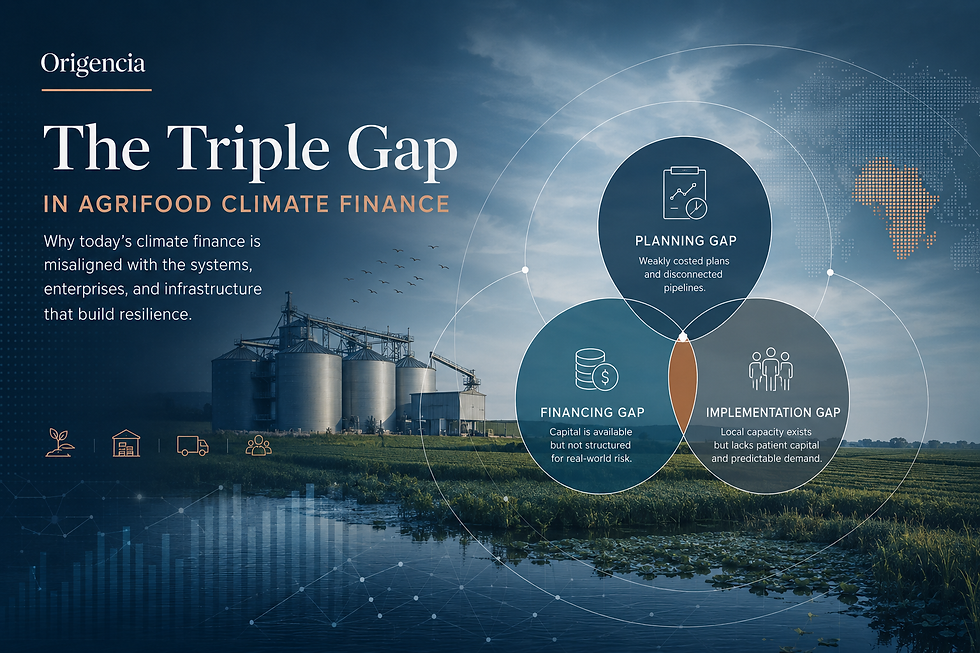
The result is a triple gap:
Planning gap: Climate and food-system strategies exist, but they are often insufficiently costed or disconnected from investable project pipelines.
Financing gap: Capital is available, but financial structures frequently avoid the risks, transaction costs and operating complexity associated with smallholder-linked agrifood systems.
Implementation gap: Local enterprises and institutions may have the capacity to deliver, but often lack patient capital, predictable demand and financing structures suited to their operating realities.
The result can be a system that appears adequately supported at the strategy level while remaining vulnerable at the point of implementation.
Why This Matters
Resilience remains infrastructure-light.Underinvestment in storage, logistics, processing and post-harvest systems can increase losses, amplify price volatility and leave food systems dependent on repeated emergency responses.
Adaptation lags ambition.Climate strategies increasingly emphasize resilience, but financing patterns do not always reflect that priority.
Private capital remains cautious.Without effective risk-sharing mechanisms, commercial investors often avoid the operationally complex parts of agrifood systems where resilience investment is most needed.
Policy credibility is tested.Food-system and climate strategies risk losing credibility if financing architecture remains disconnected from implementation requirements.
What to Watch
Whether agrifood climate finance shifts from isolated pilots toward repeatable investment vehicles.
Expansion of financing for storage, cold-chain, processing, logistics and agrifood SMEs.
Greater use of guarantees, first-loss capital and other risk-sharing mechanisms.
Whether national climate and food-system strategies begin producing clearly costed, investable project pipelines.
Whether development finance institutions increasingly use public capital to mobilize private investment into harder-to-finance segments of agrifood systems.
Decision Implication
For climate and finance ministries, development finance institutions and investors, the central question is no longer simply how much climate finance can be mobilized for food systems.
It is where that capital is deployed and how it is structured.
Without financing mechanisms capable of reaching the infrastructure, enterprises and operating systems where resilience is built, additional climate finance may increase headline commitments without materially reducing underlying vulnerability.
Bottom Line
Closing the agrifood climate finance gap will require more than larger funding commitments.
It will require better alignment between climate strategies, investable projects, risk-sharing mechanisms and the enterprises responsible for implementation.
The next phase of agrifood climate finance will therefore be defined less by how much capital is announced than by whether financing begins to reach the parts of the system where resilience is actually built.
Analysis draws on research from Climate Policy Initiative, the Food and Agriculture Organization of the United Nations, ReSAKSS and the World Bank on agrifood climate-finance needs, adaptation financing and food-system vulnerability.


STAY INFORMED