Analysis
Jan 21, 2026
Global, Sub-Saharan Africa
Where Agrifood Climate Capital Fails to Reach, and Why That Pattern Persists
By Cedric Habiyaremye
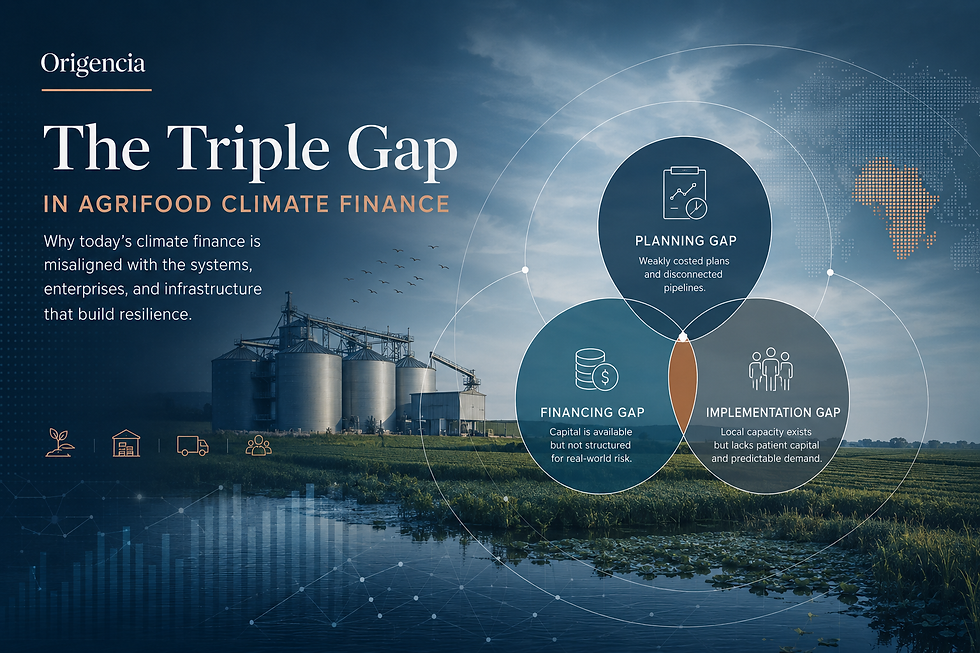
Climate capital continues to bypass the midstream infrastructure, SMEs and service markets where agrifood resilience is often built, revealing a persistent structural allocation problem.

Climate finance increasingly recognizes agrifood systems as a priority, yet capital continues to bypass many of the infrastructure, enterprises and services where resilience is actually built. The persistence of this pattern points to a problem in financial architecture, not simply a shortage of funding.
Why This Matters Now
Recent analysis from multilateral and research institutions converges on a consistent finding: climate finance flowing to agrifood systems remains small relative to the scale of climate risk, vulnerability and stated policy ambition, particularly for adaptation.
Countries have developed increasingly detailed climate strategies and food-system pathways, but financing patterns have not shifted at the same pace.
The result is a recurring disconnect between where resilience is discussed and where capital is ultimately deployed.
Understanding that disconnect requires looking beyond aggregate funding levels to the allocation rules, risk frameworks and institutional structures that determine which parts of agrifood systems are considered financeable.
How Climate Finance Is Allocated
Agrifood climate finance is commonly routed through national and multilateral planning processes, large public programs and investments that can be clearly classified within established climate-finance frameworks.
These structures tend to favor interventions that are:
Sovereign or quasi-sovereign.
Large enough to justify transaction and reporting costs.
Relatively straightforward to categorize.
Supported by standardized monitoring and accountability systems.
Lower in operational complexity.
This allocation logic shapes not only how much capital reaches agrifood systems, but where within those systems it is most likely to land.
Activities that fit established climate-finance categories are easier to fund.
Activities sitting between agriculture, infrastructure and commercial enterprise are often harder.
The Recurrent Financing Blind Spots
Across markets, several parts of agrifood systems remain persistently difficult to finance.
Post-Harvest and Midstream Infrastructure
Storage, cold chains, aggregation, logistics and basic processing play a central role in reducing losses, stabilizing supply and helping food systems absorb climate shocks.
Yet these assets occupy an awkward position within conventional financing structures.
They are agricultural in function, infrastructural in capital requirements and often commercially operated by private enterprises.
That ambiguity matters.
If a cold-storage facility is not consistently recognized as an adaptation asset, for example, it may struggle to access climate-aligned financing even when it materially reduces food losses and vulnerability to temperature and supply disruptions.
The result is an adaptation agenda that can remain relatively strong at the strategy level while being weak in the physical infrastructure required for implementation.
Small and Medium Agrifood Enterprises
Small and medium enterprises perform many of the functions connecting farms to markets, including aggregation, transport, processing, storage and service provision.
They are therefore central to how resilience moves through an agrifood system.
Yet they also present challenges for conventional climate-finance structures.
Individual investments can be relatively small. Operating models may depend on fragmented suppliers. Revenues can be seasonal. Collateral may be limited. Transaction costs can be high relative to the amount of capital deployed.
These characteristics can make SMEs difficult to finance even when their economic and climate relevance is clear.
The result is a persistent gap between policy ambition and the enterprises expected to implement it.
Input, Service and Advisory Markets
Seed systems, soil inputs, mechanization services and agricultural advisory providers influence the capacity of farmers to adapt to changing climatic conditions.
But their climate benefits are often diffuse.
A resilient seed system may improve outcomes across thousands of farms. Better advisory services may change production practices over time. Mechanization or soil services may increase productivity and reduce vulnerability without producing a single easily attributable climate outcome.
These benefits are real, but harder to measure within financing systems designed around clearly defined assets or projects.
As a result, important enabling markets can remain outside the main flow of climate-aligned capital.
Why the Pattern Persists
The persistence of these financing gaps is not primarily a problem of awareness.
Agrifood vulnerability is well documented. National strategies increasingly recognize food-system resilience. Development institutions routinely identify agriculture as a major adaptation priority.
The harder problem lies in financial architecture.
Three features are particularly important.
Eligibility
Climate-finance frameworks determine which assets and activities qualify as climate investments. When definitions are narrow, commercially important resilience infrastructure can fall between institutional categories.
Risk
Many agrifood investments involve small enterprises, fragmented suppliers, climate-sensitive revenues and limited collateral. Conventional financial institutions frequently price these characteristics as risk without fully accounting for the resilience value the investment may create.
Accountability
Climate-finance institutions must demonstrate measurable outcomes. Emissions reductions can often be quantified more directly than avoided food losses, increased system reliability or strengthened adaptive capacity.
This can create an institutional preference for interventions with clearer reporting metrics even when other investments may have substantial resilience value.
What This Is Not
The financing pattern should not be interpreted as evidence that agrifood systems are absent from climate policy.
Nor does it reflect a lack of national strategies or insufficient evidence of climate vulnerability.
The more consequential issue is the translation from recognition to financing.
Governments and institutions may agree that agrifood resilience matters while still relying on financing systems that struggle to support the enterprises, infrastructure and services required to deliver it.
Strategic Implications
If current allocation patterns persist, several consequences follow.
Adaptation remains infrastructure-light.Countries may continue developing resilience strategies without sufficiently investing in the storage, logistics, processing and market systems required to withstand disruptions.
Climate shocks continue generating recurring losses.Weak post-harvest and commercial systems leave producers and consumers exposed even when farm-level adaptation improves.
Private capital remains cautious.Without guarantees, blended structures or other forms of public risk-sharing, commercial investors have limited incentive to enter operationally complex agrifood segments.
Implementation remains fragmented.National food-system and climate strategies can struggle to move from policy commitments to durable operating capacity.
Over time, these weaknesses compound.
The cost is not simply slower climate progress. It can also appear in higher food losses, greater price volatility, weaker rural enterprises and repeated reliance on emergency responses.
What to Watch
Whether adaptation-finance definitions expand to include storage, cold-chain, processing and other midstream infrastructure.
Whether climate funds develop instruments specifically suited to agrifood SMEs.
Greater use of guarantees, blended finance and other mechanisms that reduce risk for private investors.
Whether financing frameworks begin recognizing avoided losses and system reliability as measurable adaptation outcomes.
Whether national climate strategies generate costed and investable pipelines rather than remaining primarily planning documents.
Whether more capital reaches service markets that enable farm-level adaptation.
Decision Implication
For governments, development finance institutions and climate investors, increasing the volume of agrifood climate finance will not be sufficient if allocation rules remain unchanged.
The more important question is whether financing architecture can evolve to recognize and support the infrastructure, enterprises and services that sit between national climate ambition and real-world resilience.
Capital that continues to concentrate where projects are easiest to classify and report may leave the most operationally important parts of agrifood systems underfunded.
Bottom Line
The agrifood climate-finance gap is not only about scarcity.
It is also about reach.
Capital repeatedly struggles to move into post-harvest infrastructure, SMEs and enabling service markets because these parts of the system do not fit easily within established categories of climate investment.
Until eligibility rules, risk-sharing mechanisms and accountability frameworks evolve, greater climate ambition may continue to coexist with weak implementation capacity.
The central challenge is therefore not simply mobilizing more climate finance.
It is building a financing system capable of reaching the places where resilience is actually created.
Analysis draws on research from Climate Policy Initiative, the Food and Agriculture Organization of the United Nations, ReSAKSS and the World Bank on agrifood climate finance, adaptation and food-system vulnerability.


STAY INFORMED